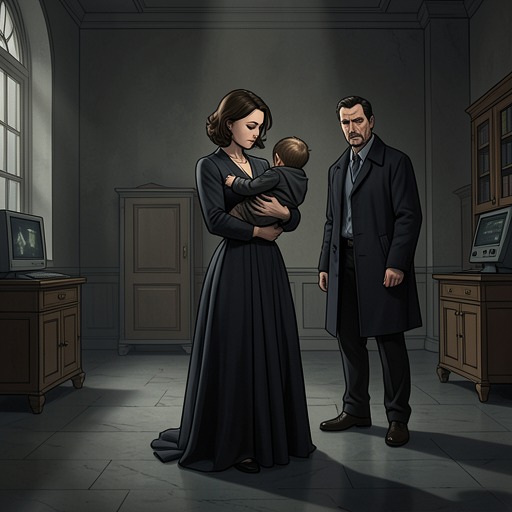
Cersei Lannister
A Clash of KingsCersei Lannister occupies power as Joffrey Baratheon’s regent, but her authority is never secure enough to become effortless. Her encounters with Tyrion Lannister show a woman who treats political life as a contest of nerve, information, and family leverage. She can command a room, threaten punishment, and defend her children with ferocity, yet the same scenes expose rage, fear, and despair beneath the performance of royal control.
Identity and Political Position
Cersei’s first major encounter with Tyrion Lannister places her at the center of the king’s Small Council, where five councillors abruptly end their discussion when he enters. She receives him with disbelief and distaste, asking what he is doing there, while he studies the political theater around her and recognizes that she regards weakness as something to be detected and exploited. Her status is therefore more than ceremonial: she is the effective guardian of Joffrey Baratheon’s rule and expects others to acknowledge that hierarchy immediately.
Her authority is also defined by its limits. Tyrion reminds her that she summoned their father, Tywin Lannister, rather than him, because Tywin commands the army and Jaime Lannister remains captive. Cersei rejects the claim that she needs Tyrion’s assistance, but Tyrion identifies the concealed motive behind her resistance: she wants Jaime returned. His reading of her face finds not only anger but fear and despair, suggesting that her political posture cannot fully conceal her dependence on the family members whose power and safety are bound to her own.
Family, Power, and Threat
Cersei’s relationship with Jaime is presented as both a source of strength and a point of vulnerability. When Tyrion says that Jaime is his brother no less than hers and promises to help free him, Cersei’s hostility becomes part of a negotiation over family survival. She does not answer as a detached regent weighing policy; she reacts as a sister whose political decisions are shaped by the captivity of someone she cannot afford to lose. Tyrion’s leverage comes from understanding that private attachment beneath public authority.
The same mixture of family protection and political calculation governs her response to Myrcella’s proposed marriage. When Tyrion suggests sending Myrcella to a Dornishman, Cersei calls the idea an attempt to sell her daughter “like a bag of oats,” and insists that Myrcella is her only daughter. She strikes the wine cup from Tyrion’s hand after he presses the point, declaring that she is Joffrey’s regent and that Myrcella will not be shipped away as Cersei herself was sent to Robert Baratheon. Her objection is therefore not merely strategic. She interprets the proposed marriage through the memory of her own political marriage, resisting the conversion of her daughter into a dynastic instrument even while ruling within a system that makes such conversions fundamental.
Cersei’s methods become more threatening when she reveals that she has seized Shae, Tyrion’s lover. She presents the information as a weapon, knowing that control of another person’s secret can be more effective than open force. Tyrion attempts to deflect the revelation with humor, but Cersei’s knowledge changes the balance between them. Her power rests on surveillance and pressure as much as on rank, and her ability to reach into Tyrion’s private life makes the family conflict inseparable from the wider struggle for control of the court.
Complicity and the Making of a Widow
Cersei gives Tyrion a brutally direct account of Robert Baratheon’s death. She says that Robert helped bring about his own end by drinking strongwine supplied by Lancel Lannister before going boar hunting. The wine was his familiar sour red, but fortified to three times its usual potency; Robert drank one skin and demanded another, after which the boar killed him. Cersei recounts the death with grotesque culinary triumph, describing the boar’s meat cooked with mushrooms and apples and tasting like victory.
The account establishes Cersei’s willingness to treat murder as an extension of political management while preserving a measure of deniability. Robert is said to have made the fatal choices himself, but Cersei and her allies arranged the conditions that made those choices deadly. Her pleasure in describing the feast is as revealing as the plot itself: the king’s death is not remembered as a tragedy but as the removal of an obstacle. Tyrion’s observation that she was born to be a widow turns the scene into an exchange of mutually recognized hostility, in which wit briefly masks the danger of what has been admitted.
Law, Vows, and Competing Orders
Cersei’s conduct can be read against the book’s wider conflict between formal law, family obligation, political necessity, and religious or military vows. Her authority as regent permits her to speak in the language of governance, but her decisions are repeatedly driven by kinship: Jaime’s captivity, Myrcella’s marriage, Robert’s removal, and the protection of Shae as a pressure point against Tyrion. The result is not a single coherent legal order but a political world in which each actor claims the right to define which obligation matters most.
This conflict appears elsewhere in the same narrative through the Night’s Watch and the treatment of Craster. Jeor Mormont tells Jon Snow that Craster has sworn no vows to the Watch and is not subject to its laws, even though Jon considers him brutal and unjust. Cersei’s politics operate by a similarly selective logic, though without the Watch’s institutional restraint: family, regency, and survival determine which rules deserve enforcement. The contrast clarifies her character. She does not simply disregard law; she treats law as one instrument among several, subordinate whenever it threatens the people or power she has chosen to defend.
Characteristic Contrasts and Narrative Role
Cersei is capable of being politically perceptive without being emotionally secure. She recognizes the danger posed by Tyrion, understands the value of hidden information, and acts decisively when her children or her authority are threatened. Yet her conversations also show how quickly control gives way to slapping, rage, and verbal violence. Her certainty that Tyrion is a “disgusting little worm” coexists with the anxiety that he may possess alliances she cannot dominate, while her insistence on being regent is shadowed by the possibility that others may treat her as merely a temporary holder of power.
Her position also forms a sharp contrast with characters governed by different kinds of vows. Jaime Lannister explains that the obligations imposed on a knight can conflict: defending the king, obeying a father, loving a sister, protecting the innocent, defending the weak, respecting the gods, and obeying the laws cannot always be fulfilled together. Cersei’s politics embody the same collision from another angle. She chooses blood and power over universal principle, but the narrative does not present those choices as costless or simple. Her family loyalty is genuine, her methods are ruthless, and her authority depends on the continuing success of the very people whose failures could destroy it.
Cersei’s decisive significance lies in this instability. She is neither merely a flat embodiment of cruelty nor a secure monarch whose motives can be reduced to ambition. Her scenes repeatedly turn public authority into private exposure: the regent fears for Jaime, the mother resists Myrcella’s political disposal, and the queen reveals that Robert’s death was engineered while pretending it was self-inflicted. Through her, power appears as something maintained by threats, secrets, and emotional attachments that can never be fully separated from one another.